Chapter Reading Time
28 minutes
Key Concepts
International Humanitarian Law – Operational Norms – Interpretation
Guiding Questions
When does a legal rule genuinely help humanitarian action?
Explore Further
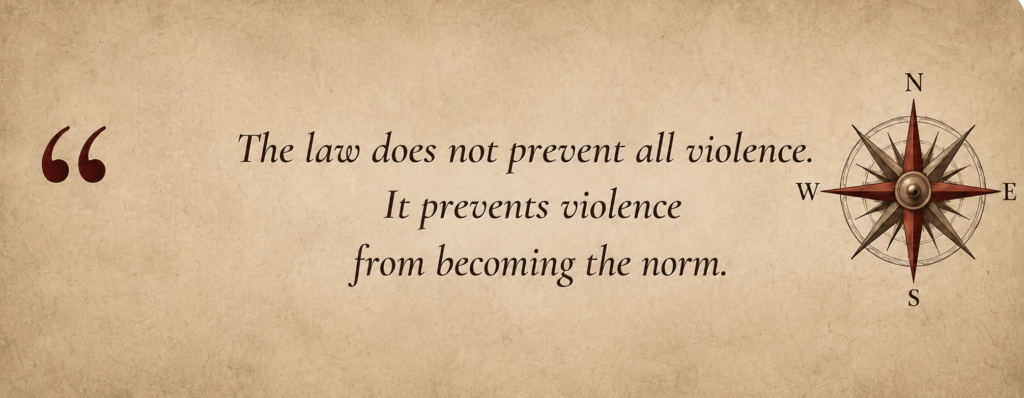
International Humanitarian Law is not a catalogue of prohibitions, but a set of tools designed to reduce suffering. It works only when those applying it know it, understand it, and use it with intelligence and flexibility.
In humanitarian crises, the law does not come before politics, nor after it.
It is present while decisions are being made.
That is why knowing the rules is not enough: they must be interpreted and adapted to the context, without betraying their spirit.
Neutrality does not mean equidistance from violations.
It means not taking part in hostilities, while remaining on the side of people.
The law does not protect on its own: it needs will, competence and courage.
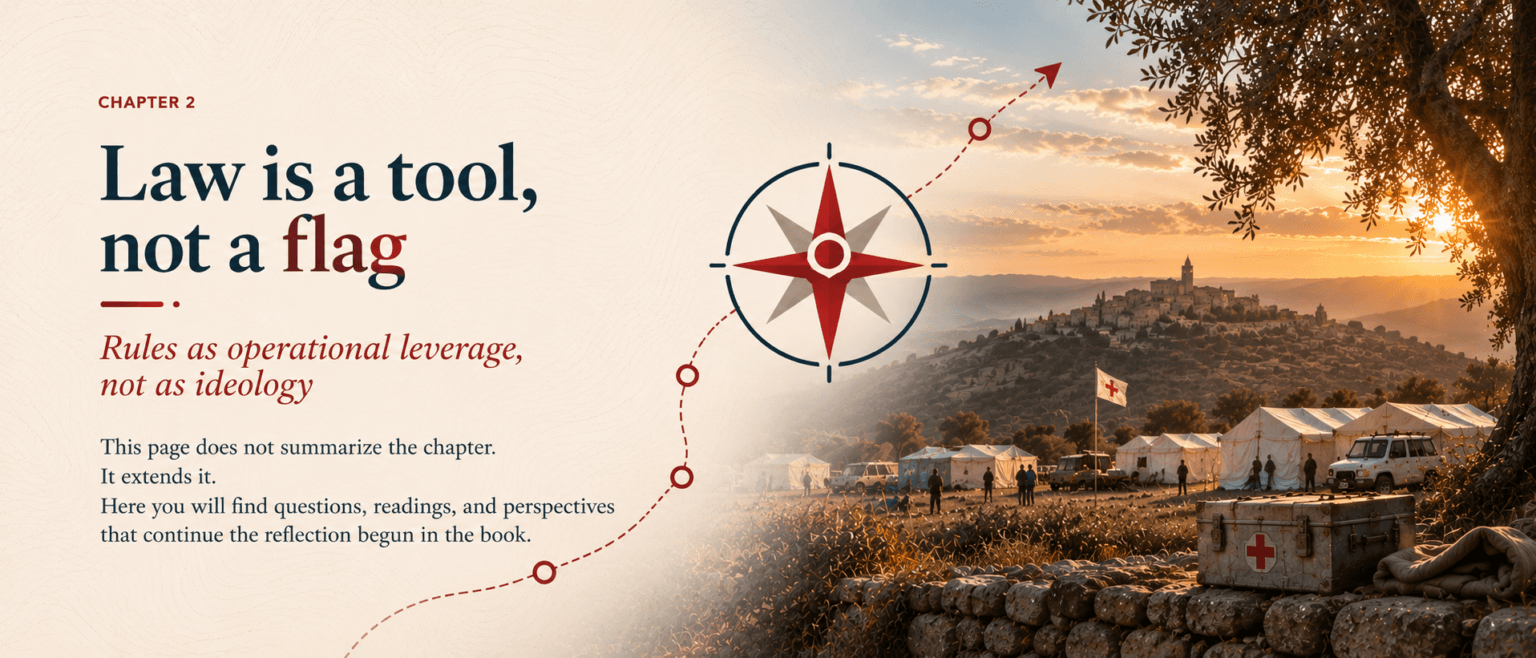
Above all, it needs to be used as a tool, not displayed as a flag.
Questions That Remain Open
How can we use the law to protect without falling into the trap of “formal legality”?
How can International Humanitarian Law interact with Human Rights Law and Refugee Law?
What are the risks of applying legal rules too rigidly in extreme contexts?
To Continue the Journey

How Does Law Protect in War? -
ICRC
Organised around themes and real-world situations, this resource shows how the law protects people, property and activities during armed conflict, while also highlighting its limitations and the challenges of applying it in practice.
Read More →
Humanitarian Ethics: A Guide to the Morality of Aid in War and Disaster - Hugo Slim
Slim explores the relationship between responsibility, operational decision-making and the moral consequences of humanitarian action, offering a complementary perspective to the legal framework presented in this chapter.
Explore Further →
International Humanitarian Law and the Challenges of Contemporary Armed Conflicts - ICRC
This report examines how International Humanitarian Law is interpreted and applied in response to the changing nature of contemporary armed conflict: urban warfare, new technologies, cyber operations, non-State armed groups and other emerging challenges.
View →
Events, Podcasts and Expert Conversations on International Humanitarian Law -
Geneva Academy
The Geneva Academy promotes ongoing dialogue among academics, humanitarian practitioners and legal experts on contemporary challenges in International Humanitarian Law and human rights. Its webinars, conferences and podcasts offer an up-to-date perspective on how the law is evolving in situations of armed conflict.
Listen →
Casebook on International
Humanitarian Law - ICRC
A collection of real-world cases, judicial decisions, exercises and teaching materials showing how the rules of International Humanitarian Law are interpreted and applied in practice. It is an ideal resource for understanding that the law is not merely a set of rules, but a tool for guiding concrete decisions.
Explore →