The future does not come later.
It is already here.
We inhabit it every time we remain present — taking responsibility
for what our decisions set in motion.
Field Notes grow out of experience in the field
They do not try to explain humanitarian work.
They try to preserve something that risks being lost
when experience is transformed into procedures,
reports, indicators or lessons learned.

Field Notes

What Can I Do?
Protection
Refugees
Syria
Humanitarian Access
It is a question that comes back often.
Faced with war, humanitarian crisis and the displacement of millions of people, it is natural to feel small.
It is natural to wonder whether our work can really change anything.
I have asked myself the same question many times.
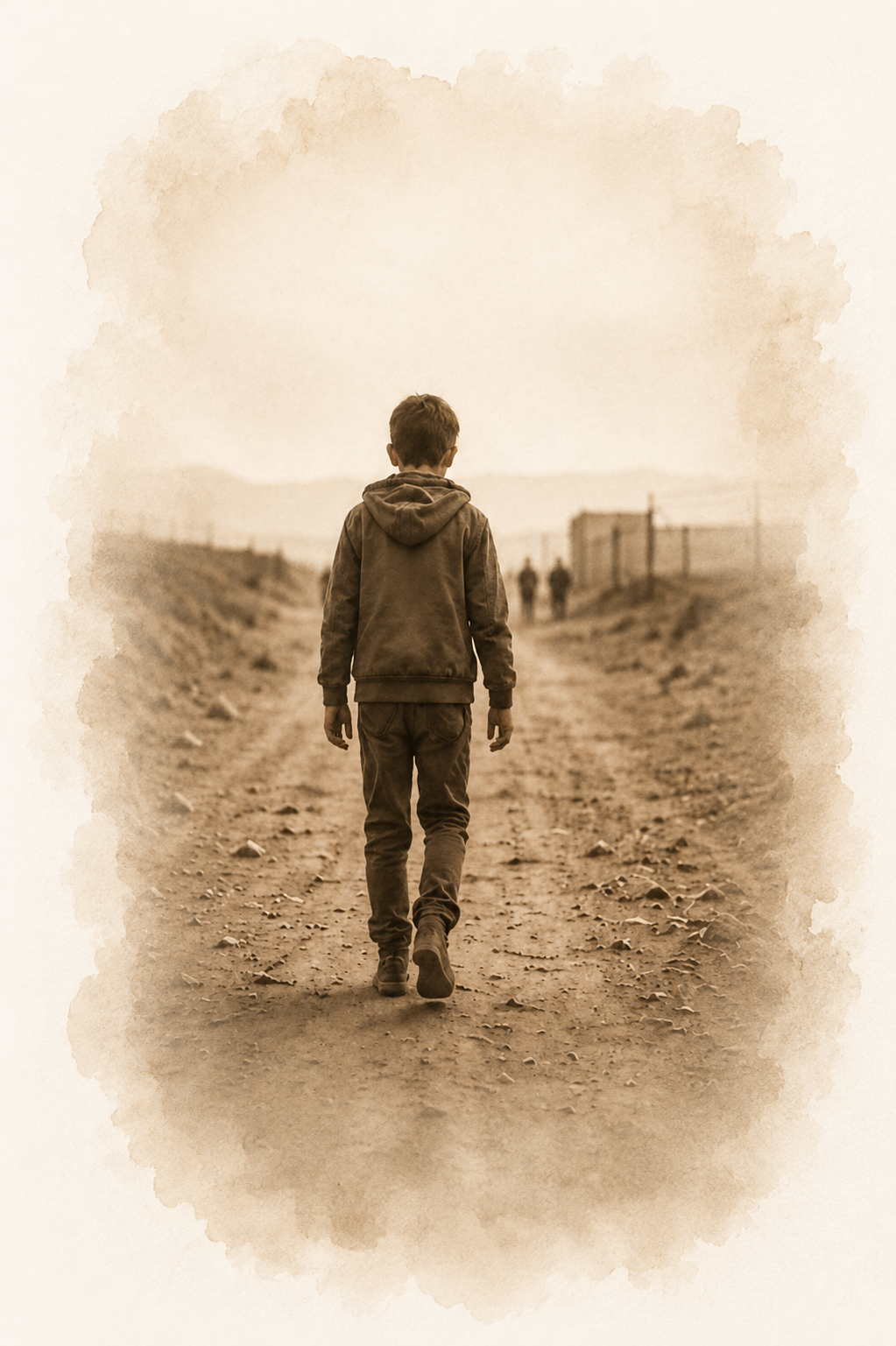
And each time, I think of a boy I met years ago on the border between Syria and Jordan.
Those were the years when Raqqa was one of the most violent epicentres of the war in Syria.
Entire areas of the country were being fought over by government forces, opposition groups, the Islamic State and air strikes.
At the Jordanian border, tens of thousands of people were stranded in the desert.
They could not enter.
Going back often meant exposing themselves to the war once again.
One day, a boy came up to me.
I asked him his name.
He looked at me and said: — Do you have a cigarette?
I smiled and said no.
Then I asked where his parents were.
That was when he began to tell me his story.
He said his father had been killed.
That the school had closed.
That playing football had become impossible.
He never used these words, but it was clear that, for him, childhood had ended long
before he turned thirteen.
One night, he had left on his own.
He had crossed Syria.
He had crossed the desert.
He had crossed the war.
He had managed to reach Jordan.
I thought that was the end of his story.
I was wrong.
After reaching a refugee camp and receiving assistance, he had decided to go back.
Alone.
To bring out his mother and his younger brothers and sisters.
He had succeeded.
And then he had gone back again.
Not for himself.
To guide other boys from his village.
Other families.
Other people who knew the war, but not the way out.
He travelled back and forth along the border.
He knew the route. He knew where to find water.
He knew which areas to avoid.
He had turned that knowledge into something that could help others.
When I met him, he had been stopped by Jordanian soldiers during one of these attempts.
What struck me was not his courage.
It was the way he thought.
He did not speak like someone who wanted to change the world.
He had simply identified one part of reality where he could make a difference.
He could not stop the war.
He could not save everyone.
But he could guide someone along a stretch of road he had come to know.
Over the years, I have often thought back to that encounter.
Whenever I have asked myself what humanitarian work is really for, the same image has returned to me.
Perhaps the question was never: “How can we solve a crisis?”
Perhaps the right question is more modest.
And precisely for that reason, more difficult.
What can we do, with what we know, for the person standing in front of us today?
Humanitarian Resistance
Humanitarian Ethics
Humanitarian Principles
Humanitarian Action
The Future of Humanitarian Action
Every era finds the word through which it tells its own story.
In recent years, one of the words used most often has been resilience.
The ability to adapt.
To absorb shocks.
To keep going despite everything.
It is an important word.
But sometimes I realise it is not enough for me.
We are living through a time of transformations that would have seemed unimaginable only a few years ago.
Wars are multiplying.
The fear of nuclear conflict has returned to everyday language.
Artificial intelligence is changing the way we work, make decisions, and even imagine the future.
Principles that once seemed settled are continually being called into question.
When I look at all of this, another word comes to mind.
Resistance.
Not, of course, armed resistance.
Humanitarian action cannot choose a side.
Its place remains alongside people who are suffering, whatever side of the front line they may be on.
The resistance I have in mind is different.
It is a word I learned long before I encountered it in history books.
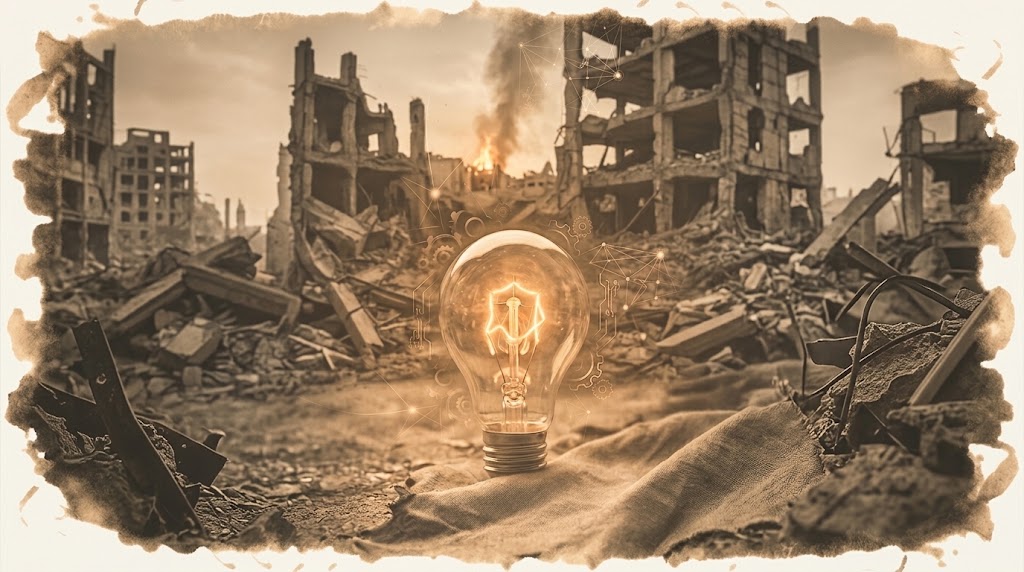
It was inside an old light bulb.
Resistance is that thin filament which, instead of blocking energy, transforms it.
Friction produces light.
Perhaps this is the image I carry with me when I think about our work.
Every day, we encounter friction.
Between principles and reality.
Between urgency and caution.
Between hope and disillusionment.
Between what we would like to do and what the context makes possible.
We can allow ourselves to be worn down by these tensions.
Or we can try to transform them.
Not into anger.
Not into resignation.
But into energy.
Humanitarian action, at least as I have experienced it, is not about passively adapting to the world as it is.
It is about remaining present enough to let what happens pass through us, without ceasing to produce light.
Perhaps this is our form of resistance.
Not the kind that defeats someone.
The kind that keeps humanity from going dark.
Because peace does not arise only from the end of wars.
It also arises from people who, every day, choose not to let friction produce only heat.
And who continue, stubbornly, to turn it into light.
Does Trust Have a Digital Fingerprint?
Humanitarian Ethics
Data Protection
Innovation
Artificial Intelligence
There are questions that seem to belong to the present.
Then you realise they have been with you for many years.
In recent months, the debate around artificial intelligence has entered the humanitarian sector with considerable force.
People are talking about algorithms, predictive systems, biometric recognition and automated data analysis.
Reading many of these contributions, I realised that, at least for me, the issue is not new at all.
The technology has changed.
The questions, however, have remained strikingly similar.
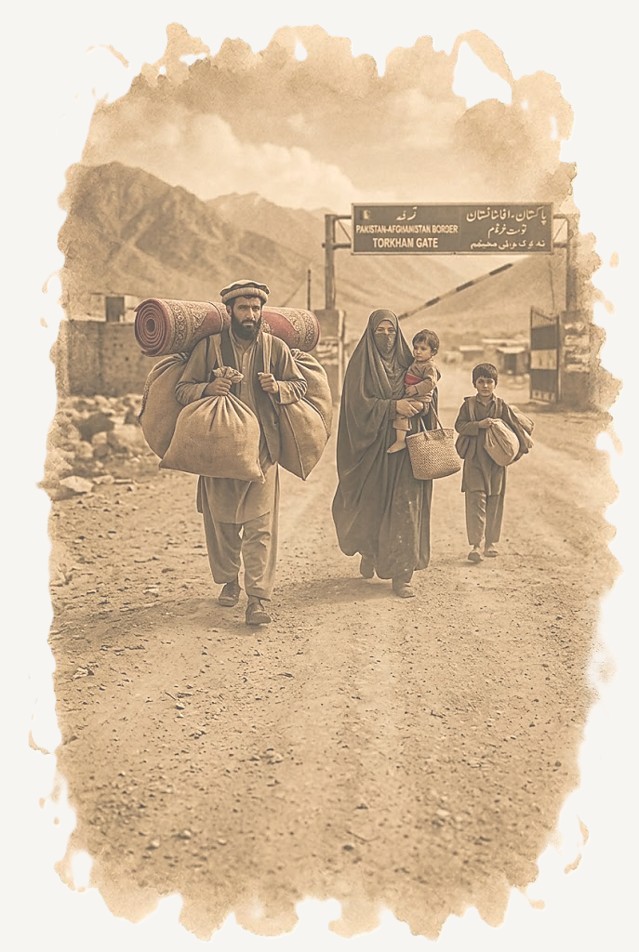
Between 2002 and 2008, more than five million Afghans returned, primarily from Pakistan and Iran. It was the period of greatest intensity of what UNHCR would later describe as the largest voluntary repatriation programme in its history. The international community sought to support that process by providing families with financial assistance intended to cover travel and the initial phase of return.
At repatriation centres in Pakistan, iris recognition was progressively introduced to verify whether a person had already benefited from the programme.
The logic was difficult to dispute.
People had to be identified correctly, fraud had to be limited, so-called repatriation recycling had to be prevented — repeated returns for the purpose of receiving the assistance package more than once — and scarce resources had to reach the intended recipients.
Operationally, it was an effective system.
In fact, it was probably the best available at the time.
I do not remember major debates about the usefulness of the tool.
What I do remember are many conversations about what that tool might come to represent.
Because the Afghan context was not only humanitarian.
It was also one of the principal theatres of the international fight against terrorism.
Alongside humanitarian organisations, military missions, intelligence services and security programmes were also operating.
For us as humanitarian practitioners, this was not a theoretical discussion.
Among the main funders of repatriation assistance were governments that were also directly involved, in the same context, in military, stabilisation and security operations.
It was not a contradiction we could resolve.
It was simply the context in which we were trying to remain faithful to humanitarian principles.
And that was where the questions began.
What would happen to those data?
I am not suggesting that they were used for purposes other than those officially stated. I have no evidence of that, and it would be wrong to claim otherwise.
But I remember very clearly the doubt that circulated among many practitioners.
When the same information may be of interest to actors with profoundly different mandates, is it enough to state that it will be used only for humanitarian purposes?
Or is the issue something even more delicate: the trust of the people who decide to hand over those data?
In the years that followed, the international debate on biometric data expanded considerably.
Some developments linked to intelligence activities showed how quickly information collected for one purpose can acquire value in entirely different contexts.
That is not the central point of my argument.
The lesson I continue to carry with me is another one.
Technology evolves much faster than trust.
Today, those same questions are resurfacing in discussions about artificial intelligence.
Algorithms promise to help us identify needs, analyse satellite imagery, organise enormous quantities of data, document possible violations of international humanitarian law and support increasingly complex decisions.
These tools can make a real contribution.
It would be a mistake to ignore that.
Reading some recent contributions from the International Committee of the Red Cross, one point in particular struck me: an algorithm does not necessarily replace the decision-maker, but it influences how that person interprets reality, assesses risk and justifies decisions.
At that point, I found myself thinking again about the Afghan experience.
Not because artificial intelligence already existed then.
But because, fundamentally, the dilemma was the same.
Every innovation increases our capacity to collect, process and use information.
Much less obvious is our capacity to anticipate the consequences that same innovation may produce several years later.
Humanitarian action has always needed data.
Without data, people cannot be identified.
Assistance cannot be distributed.
Interventions cannot be planned.
So the question is not whether to collect data or not.
The question is how to safeguard the relationship of trust that makes their collection possible.
Every person who turns to a humanitarian organisation entrusts something of themselves to it.
It may be a document, a name, an address or biometric data.
In every case, they are entrusting us with part of their vulnerability.
And it is precisely that vulnerability that requires a level of responsibility greater than in many other sectors.
This is why I sometimes think the debate around artificial intelligence risks focusing on the wrong questions.
How accurate will the algorithms be?
How much will they reduce errors?
How much more efficient will they make operations?
These are important questions.
But there is another question that comes first.
What happens when information collected to protect a person also becomes potentially useful to actors pursuing entirely different objectives?
That is certainly a question about artificial intelligence.
But even before that, it is a question about the meaning of humanitarian independence in a world where data have become a strategic resource.
I do not have a definitive answer.
Perhaps because no definitive answer exists.
What I do know is that the Afghan experience left me with one conviction that has not changed over the years.
Every new technology changes the space in which we are called upon to exercise responsibility.
It does not replace ethical dilemmas.
It shifts them.
And that is probably why I remain wary both of unconditional enthusiasm and of reflexive rejection of innovation.
Technology can help us work better.
It can make assistance more effective.
It can strengthen the protection of people.
But it can never replace the responsibility to safeguard the trust on which humanitarian action continues to depend.
Looking back today at those discussions in Afghanistan, I realise that we were not talking only about biometrics.
We were already trying to understand what kind of relationship we wanted to build between innovation, responsibility and trust.
Today that question has a different name: artificial intelligence.
But, at heart, it is the same question we were asking then.
Further Reading
UNHCR, Afghan “recyclers” under scrutiny of new technology, 3 October 2002.
UNHCR, Afghanistan: Iris-testing proves successful, 10 October 2003.
UNHCR, The use of cash grants in UNHCR voluntary repatriation operations, 2008.
UNHCR, Global Report 2008 – Afghanistan.
Wen Zhou and Anna Rosalie Greipl, Artificial intelligence in military decision-making: supporting humans, not replacing them, ICRC Humanitarian Law & Policy Blog, 29 August 2024.
Yéelen Marie Geairon, Deciding under algorithms: artificial intelligence and the protection of civilian infrastructure in armed conflict, ICRC Humanitarian Law & Policy Blog, 12 March 2026.
The System Knows. Why Does It Still Struggle to Change?
Humanitarian System
Reform
Accountability
Humanitarian Principles
Power
While some reports add information, others, perhaps more usefully, leave you with a question that is much harder to ignore: given how much we already know, why do we keep making the same mistakes?
The State of the Humanitarian System 2026, released by ALNAP, comes at a time when answers are becoming harder to find.
The report describes a humanitarian system that is smaller, more fragile, and under severe financial and political pressure.
But what resonated with me was not the scale of the funding crisis, the sheer number of emergencies, or even the system’s capacity to respond.
What is more interesting is the gap between what the humanitarian system has learned and what it has actually been able to change.
Over the last twenty years, humanitarian action has become significantly more sophisticated.
Coordination has improved. Technical standards have evolved. Evaluation systems are stronger. Cash programming has become more widespread. Anticipatory action has become more common, while analysis and data collection have become more refined.
These are important gains, and the report does not shy away from acknowledging them.
Yet they sit alongside a more troubling conclusion.
The system has been far more capable of improving technical aspects than of changing the conditions under which decisions are actually made: power, incentives, organisational behaviour, institutional interests, and internal cultures.
That distinction matters.
The real challenge increasingly lies in what happens when knowledge has to be turned into a decision in the middle of a crisis.
The report provides a stark illustration.
Humanitarian actors can usually define the humanitarian principles.
But that confidence weakens when those same principles have to be applied to actual decisions.
Anyone who has worked in complex operational settings will recognise that gap.
Humanitarian principles such as humanity, impartiality, neutrality, and independence do not, by themselves, tell you what to do when the access you need depends on a de facto authority; when a donor attaches political conditions; when some groups are excluded; or when maintaining any presence at all requires some form of compromise.
This is where the real work begins, because humanitarian practice has to move beyond doctrine.
The SOHS uses a helpful expression: principled pragmatism.
In complex settings, a degree of compromise on neutrality, independence, and impartiality may be unavoidable if a presence is to be maintained.
Frontline practitioners negotiate constantly with authorities, armed groups, and other holders of power, often without sufficiently clear guidance on how far such compromises can go or where the real red lines lie.
No additional procedure will settle that question in advance.
At some point, judgement has to enter.
Localisation reveals much the same problem.
Ten years on from the Grand Bargain, only a limited proportion of resources reaches local and national actors directly, while their influence in the main spaces of decision-making remains constrained.
The report continues to describe transactional partnerships, transferred risk, and limited influence over priorities.
Funding is always important. But it is not the whole story.
Who sets priorities? Who decides which risks are acceptable? Who decides what counts as knowledge, and whose judgement is heard?
These questions bring the debate back to power, colonial legacies, trust, and decision-making — all areas that the report identifies as still unresolved.
Accountability shows a similar tension.
Over the years, the sector has created frameworks, feedback mechanisms, standards, and reporting systems.
And yet the SOHS notes that accountability is still too often treated as a technical function, separate from decision-making.
Communities may be consulted, feedback may be collected, and mechanisms may be in place, but the actual influence of that feedback on programmes and priorities remains limited.
Technology makes the same problem even more visible.
Digital tools have improved efficiency in many areas of humanitarian action.
At the same time, biometric systems, artificial intelligence, and automated decision-support tools have advanced faster than the governance and data-protection mechanisms meant to accompany them.
According to the SOHS, only 41% of people surveyed said they understood how their data was being used; among younger respondents, the figure fell to 32%.
The issue is therefore not simply whether the technology works.
It is whether organisations are prepared to take responsibility for what follows from using it.
Across these very different areas, the same tension keeps reappearing.
The humanitarian system knows far more than it did twenty years ago.
It has better data, more standards, stronger technical capacities, and an enormous body of evaluations, lessons learned, guidance, and recommendations.
And yet the questions that continue to trouble the system remain surprisingly familiar: power, access, trust, responsibility, compromise, legitimacy.
Today’s financial contraction makes this especially important.
There is a real risk that the sector responds by doing “the same but smaller” — preserving the same architecture, incentives, and decision-making habits with fewer resources.
That would be a missed opportunity.
The humanitarian system works.
The SOHS documents a broad range of achievements: lives saved, outbreaks contained, progress in nutrition, the effectiveness of cash programming, operational reach, and innovation.
The deeper problem lies elsewhere: growth in technical capacity has outpaced the system’s appetite — and perhaps its willingness — to question how power is exercised and how difficult decisions are made.
So perhaps we should spend less time asking. What do we still need to learn?
And more time asking: What do we already know, but still have not managed to change?
A compass will not fix that problem, but it can help us recognise when we are going around in circles.
And that may be a useful place to begin.