
Chapter Reading Time
28 minutes
Key Concepts
Localisation – Local Partnerships – Shared Leadership – Shared Responsibility – Adaptation
Guiding Questions
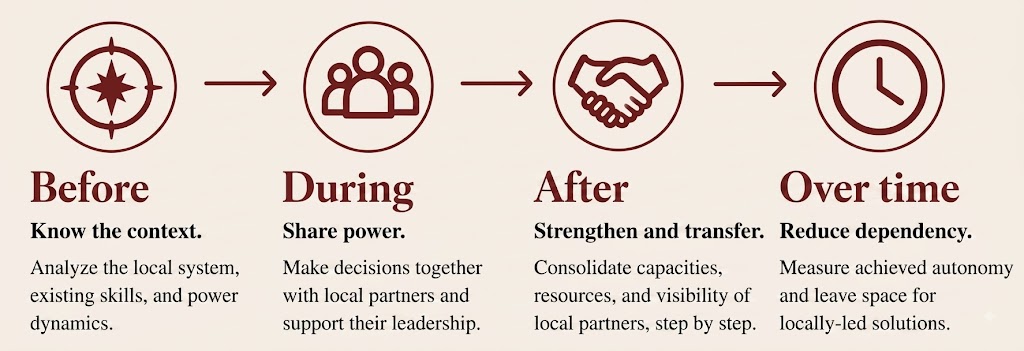
How can we make decisions together while taking into account those who are here, those who remain, and those who will still be here after we are gone?

Explore Further
Where does localisation really begin?
Localisation is not simply about “doing things in the right place”.
It is about building shared legitimacy.
It means recognising existing capacities.
It means investing in relationships that build trust over time.
Whenever we talk about localisation, we tend to imagine transferring capacity.
It is almost always the first image that comes to mind.
Much more rarely do we ask what it really means to share the right to make decisions, to take risks, and to define priorities.
Perhaps that is where localisation really begins.
Localisation also means accepting that not everything will be under our control.
It means building alliances in which no one has all the answers, but everyone has something to contribute.
Questions That Remain Open
What mechanisms can we put in place to genuinely share decision-making power?
How can we prevent localisation from becoming merely a change of labels?
How can we build alliances that continue to generate value even after the project ends?

Room for Manoeuvre
WHO REALLY BEARS THE RISK?
Before making decisions together, try mapping who bears the risks and
who receives the benefits.
Reflect on how power dynamics, resources and context shape decisions.
Perfect symmetry does not exist: the objective is to recognise asymmetry, not ignore it.
This is the first step towards building shared responsibility.
To Continue the Journey

As Local as Possible, As International as Necessary - Veronique Barbelet
One of the most influential contributions to contemporary thinking on localisation. Barbelet moves beyond the idea of localisation as simply a transfer of capacity, proposing instead an approach based on complementary expertise, mutual recognition and the building of more balanced partnerships. It provides the theoretical foundation closest to the perspective developed in this chapter.
Read More →
Localization: Shifting Power, Not Just Funding -
The New Humanitarian
A collection of articles addressing one of the central issues in the contemporary debate: localisation is not only about transferring financial resources, but above all about redistributing decision-making power, legitimacy and responsibility.
Explore Further →
Principles of Partnership –
Global Humanitarian Platform
The Principles of Partnership, adopted by the Global Humanitarian Platform are among the most authoritative reference points for building relationships grounded in mutual respect, complementarity, transparency, shared responsibility and reciprocity. They provide a practical framework for rethinking partnerships beyond the simple logic of funding or implementation.
View →
Fresh Humanitarian Perspectives Podcast - Humanitarian Leadership Academy
Conversations with humanitarian practitioners, local leaders and researchers reflecting on changes in the humanitarian system, partnerships, local leadership and the transformations needed to build genuinely shared humanitarian action.
Listen →
Grand Bargain Localisation Workstream – Videos & Webinars - IFRC
The channel brings together webinars and first-hand accounts from local organisations, donors, international NGOs and researchers discussing what it really means to share power, leadership and responsibility. It offers a practical perspective on the challenges of localisation, moving beyond slogans to show experiences, successes and the difficulties of implementation.
Explore →