Chapter Reading Time
32 minutes
Key Concepts
Protection – Analytical lens – Vulnerability – Risks – Responsibility – Observation
Guiding Questions
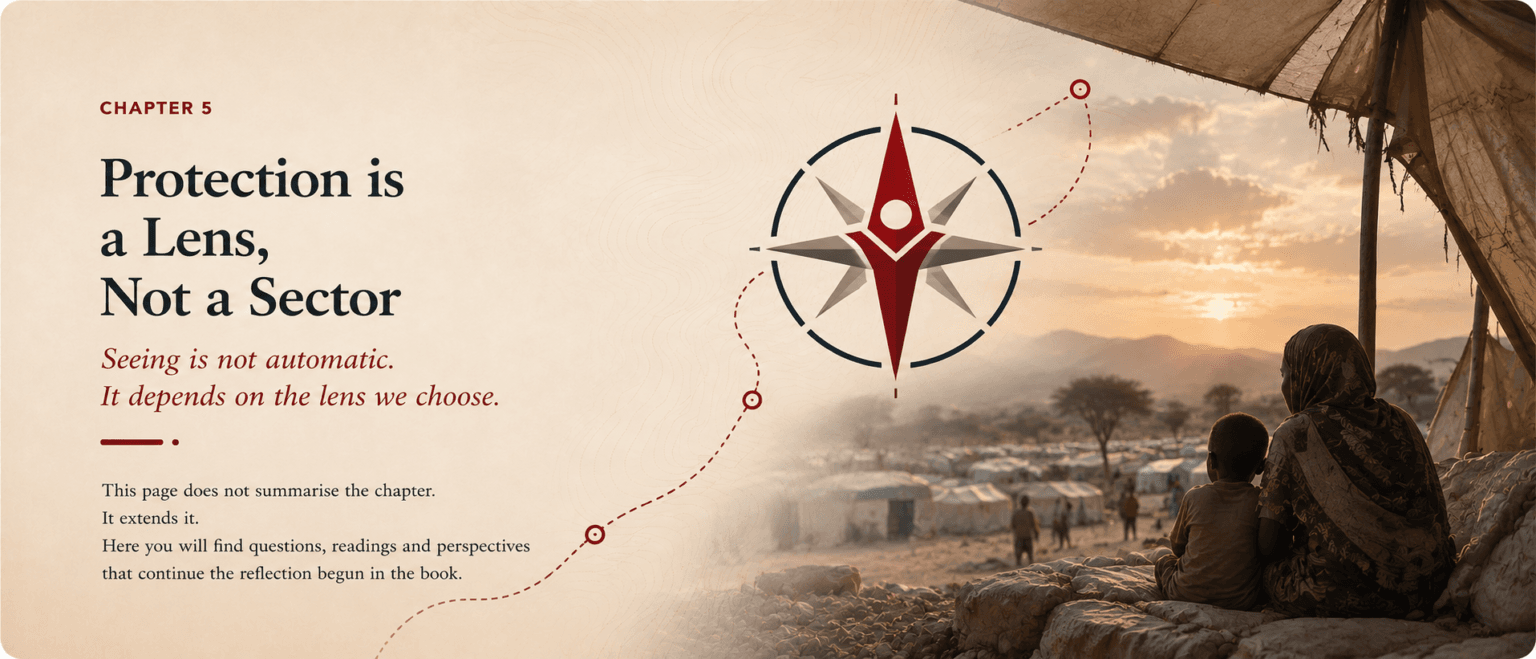
How does our approach change when we adopt a ‘protection lens’?
Explore Further
Protection is not an outcome that happens by itself.
It is the result of clear intentions, deliberate choices, and a capacity to observe that must be developed.
A well-designed intervention can still cause harm.
An accessible service can expose people to new risks.
A distribution can generate tensions or exclusion.
Seeing does not mean simply collecting information.
It means knowing how to read weak signals, recognising what remains invisible, and taking responsibility for what happens.
The quality of protection does not depend only on what we do.
It also depends on how we look, and on the lens we choose to use.
Questions That Remain Open
Which biases influence our ability to see?
Which risks are we still failing to see in our everyday activities?
How can we integrate protection into every decision, not only into dedicated projects?
To Continue the Journey

Between Samaritans and States: The Political Ethics of Humanitarian INGOs - J. C. Rubenstein
One of the most profound reflections on the ethics of contemporary humanitarian action. Rubenstein shows how humanitarian organisations are not simply providers of services, but actors that assume political and moral responsibility through the decisions they make. Essential reading for understanding protection as a relational responsibility rather than merely an organisational function.
Read More →
Do No Harm: How Aid Can Support Peace – or War -
Mary B. Anderson
A classic work that transformed the way we think about the unintended effects of humanitarian action. Anderson shows how even well-intentioned interventions can produce unforeseen consequences, reinforce conflict dynamics or increase vulnerability. The book speaks directly to the idea of protection as a lens through which to examine the effects of our decisions.
Explore Further →
Protection Mainstreaming Toolkit -
Global Protection Cluster
The main operational reference for integrating a protection lens across all sectors of humanitarian action. It provides practical tools to ensure that every programme systematically considers risks, vulnerabilities and the consequences of its decisions.
View →
The Civilian Protection Podcast -
PAX - Protection of Civilians
Conversations with humanitarian practitioners, researchers and people directly affected by conflict that place the perspective of civilians at the centre. An invitation to understand protection not only as a concept, but as a lived experience.
Listen →
Protection Mainstreaming Resources -
Global Protection Cluster
Videos, webinars, case studies and training materials showing how to apply a protection lens in practice throughout the design, implementation and evaluation of humanitarian programmes.
Explore →