Chapter Reading Time
32 minutes
Key Concepts
Humanitarian Principles – Independence – Neutrality – Impartiality – Political System
Guiding Questions
Can Humanitarian Principles be upheld in a system of competing interests?

Explore Further
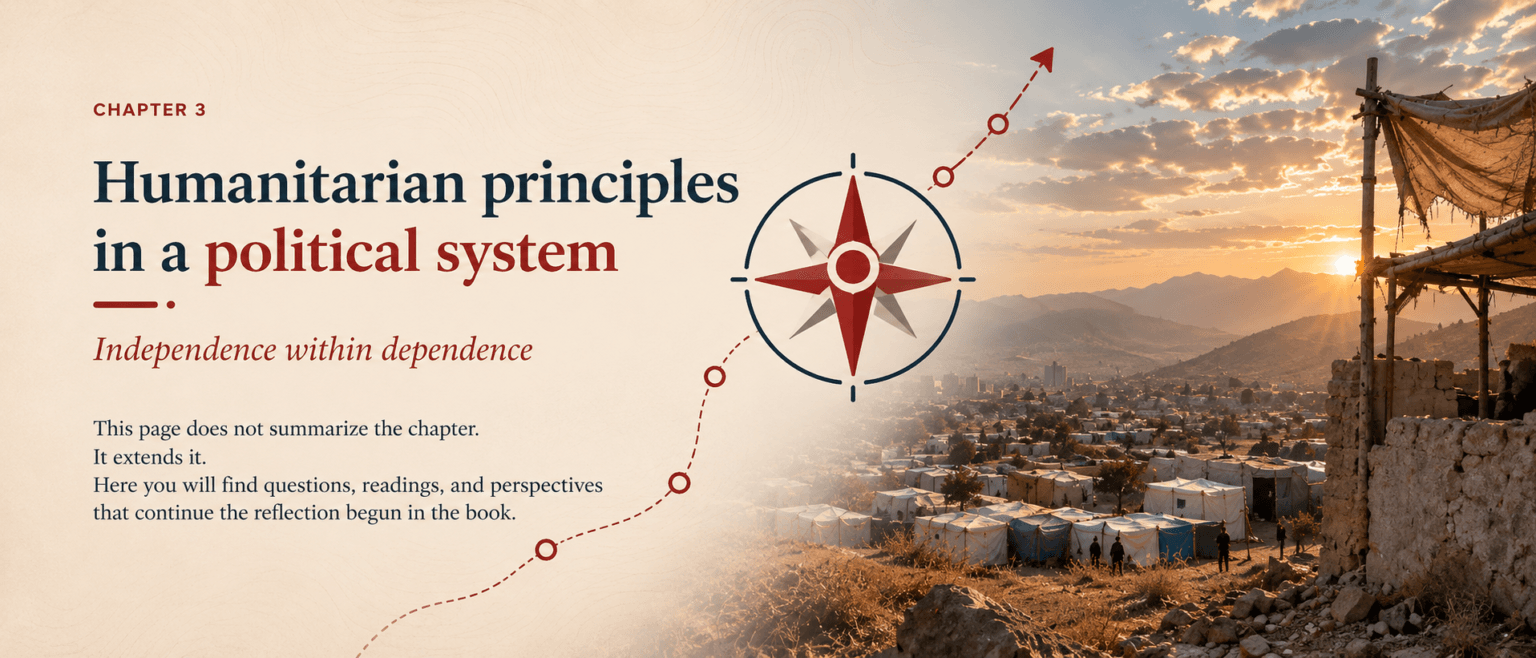
Humanitarian Principles do not live in documents.
They live in the reputation built over time, in the consistency of choices, and in the continuity of behaviours that others learn to recognise.
Independence can be affirmed and, at the same time, perceived as fragile. Neutrality can be proclaimed and still be interpreted as taking sides.
Perhaps the most difficult question is not whether an organisation respects the principles, but when others truly begin to believe that it does.Principles do not protect by declaration.
They protect when they shape practice, when they make a position recognisable, when they help others understand who you are — and who you are not.
Questions That Remain Open
When does consistency matter more than declarations?
How long does it take to build trust? How little does it take to lose it?
Which everyday behaviours make an organisation recognisable even before its words do?
To Continue the Journey

The Fundamental Principles of the Red Cross: Commentary – Jean Pictet
The foundational text that defined the operational meaning of the seven Fundamental Principles of the International Red Cross and Red Crescent Movement. It remains a key starting point for understanding how the Principles were conceived not simply as moral values, but as operational conditions that make humanitarian action possible.
Read More →
The Politics of Principle: The Principles of Humanitarian Action in Practice - Nicholas Leader
One of the most important contributions on the relationship between humanitarian principles and political reality. Leader shows how neutrality, independence, impartiality and humanity do not operate in a neutral space, but are continually reinterpreted, negotiated and tested within complex political contexts.
Explore Further →
Resolution 46/182 (1991) -
United Nations General Assembly
The resolution that formally incorporated humanitarian principles into the United Nations system. It marked the expansion of these principles beyond the International Red Cross and Red Crescent Movement into the broader multilateral humanitarian architecture, and remains one of the key reference points for the international humanitarian system today.
View →
Podcasts on Humanitarian Leadership and Operational Dilemmas - Humanitarian Leadership Academy
A collection of conversations with humanitarian practitioners, researchers and leaders of international organisations on the dilemmas of humanitarian action: independence, leadership, ethics, decision-making and the management of operational tensions. Rather than explaining the principles, these episodes show what it means to try to translate them into everyday practice.
Listen →
Humanitarian Principles in Negotiation - Research Initiative – Centre of Competence on Humanitarian Negotiation (CCHN)
One of the most comprehensive research initiatives examining the relationship between humanitarian principles and operational practice. Drawing on the experience of hundreds of humanitarian practitioners, the project analyses how neutrality, impartiality and independence are understood, interpreted and translated into everyday decision-making.
Explore →