Chapter Reading Time
24 minutes
Key Concepts
Coordination – Leadership – Complex Systems – Ambiguity – Shared Responsibility
Guiding Questions
How can we coordinate without confusing coordination with responsibility?

Explore Further
Coordination does not make decisions.
It makes decisions possible.
Meetings organise information.
They make different perspectives compatible.
They build a common language.
They create the conditions in which decisions can emerge.
But decisions are distributed across different actors, making it harder to recognise where responsibility truly lies.
Every synthesis makes reality more manageable, but inevitably leaves something at the margins.
The question is not only whether the system is well coordinated.
It is which parts of reality coordination makes visible — and which, unintentionally, it leaves out.
Questions That Remain Open
Who remains truly responsible when a decision has been shared by everyone?
Which aspects of reality fail to make it into our summaries and indicators?
When does coordination protect the system, and when does it primarily protect the balance between organisations?

Room for Manoeuvre
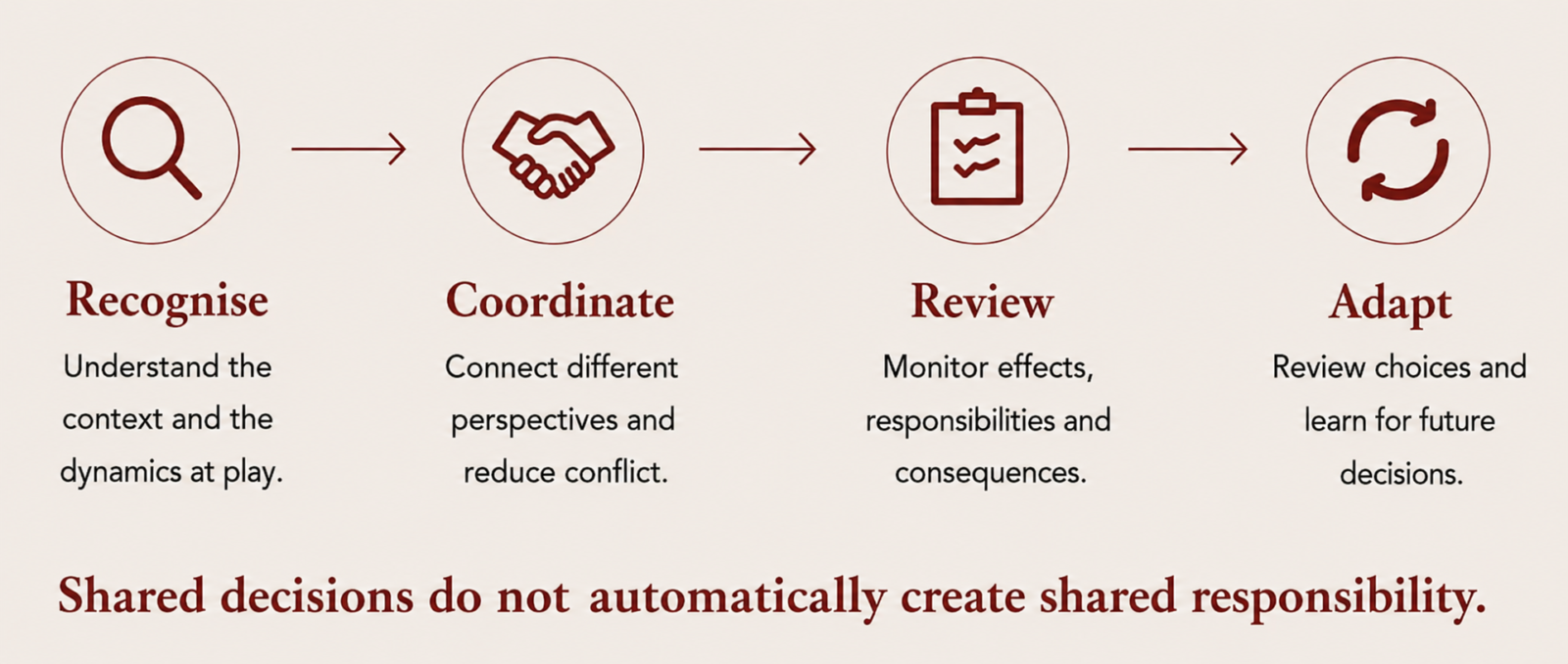
Coordinating does not mean distributing responsibility
Before asking whether coordination worked, try considering a different question.
Who will be able to explain this decision six months from now?
Not only who approved it.
Who will also be able to recognise it as their own.
To Continue the Journey

Reference Module for Cluster Coordination at Country Level - Inter-Agency Standing Committee (IASC)
The key reference document for understanding how the humanitarian coordination system is designed: clusters, the Humanitarian Country Team, shared leadership and collective responsibilities. An essential foundation for navigating the architecture of the humanitarian system.
Read More →
Exploring the Science of Complexity: Ideas and Implications for Development and Humanitarian Efforts -
Ben Ramalingam
One of the foundational texts on complexity thinking applied to international cooperation and humanitarian action. It helps explain why coordination, leadership and decision-making cannot be understood as linear processes in systems characterised by uncertainty, interdependence and continuous adaptation.
Explore Further →
OCHA HPC
Toolbox
The operational framework that describes how needs analysis, planning, coordination, monitoring and review are translated into collective decision-making within the humanitarian system. The official documentation is periodically updated by OCHA and remains the key operational reference for humanitarian planning today.
View →
Fresh Humanitarian Perspectives Podcast - Humanitarian Leadership Academy
Conversations with humanitarian leaders, coordinators and researchers on the challenges of leadership, coordination and working within complex systems.
Listen →
Humanitarian Action Explained -
OCHA
Videos, guides and multimedia resources illustrating how humanitarian coordination works, the role of OCHA, and the relationships among actors across the humanitarian system.
Explore →