Chapter Reading Time
25 minutes
Key Concepts
Access – Acceptance – Legitimacy – Security
Guiding Questions
When do we realise that we have lost acceptance?

Explore Further
When do we realise that we have lost acceptance?
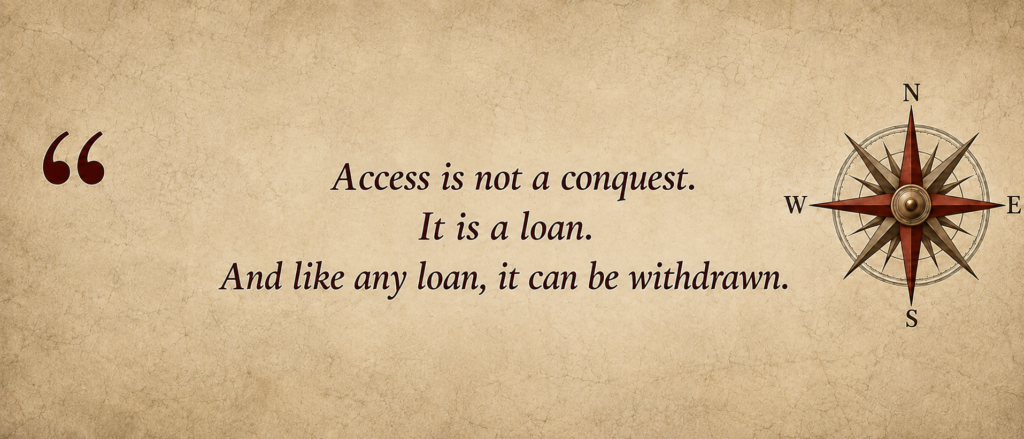
In humanitarian language, “access” is often treated as if it were a condition once achieved: once negotiated, it should simply be maintained.
Experience in the field suggests something different.
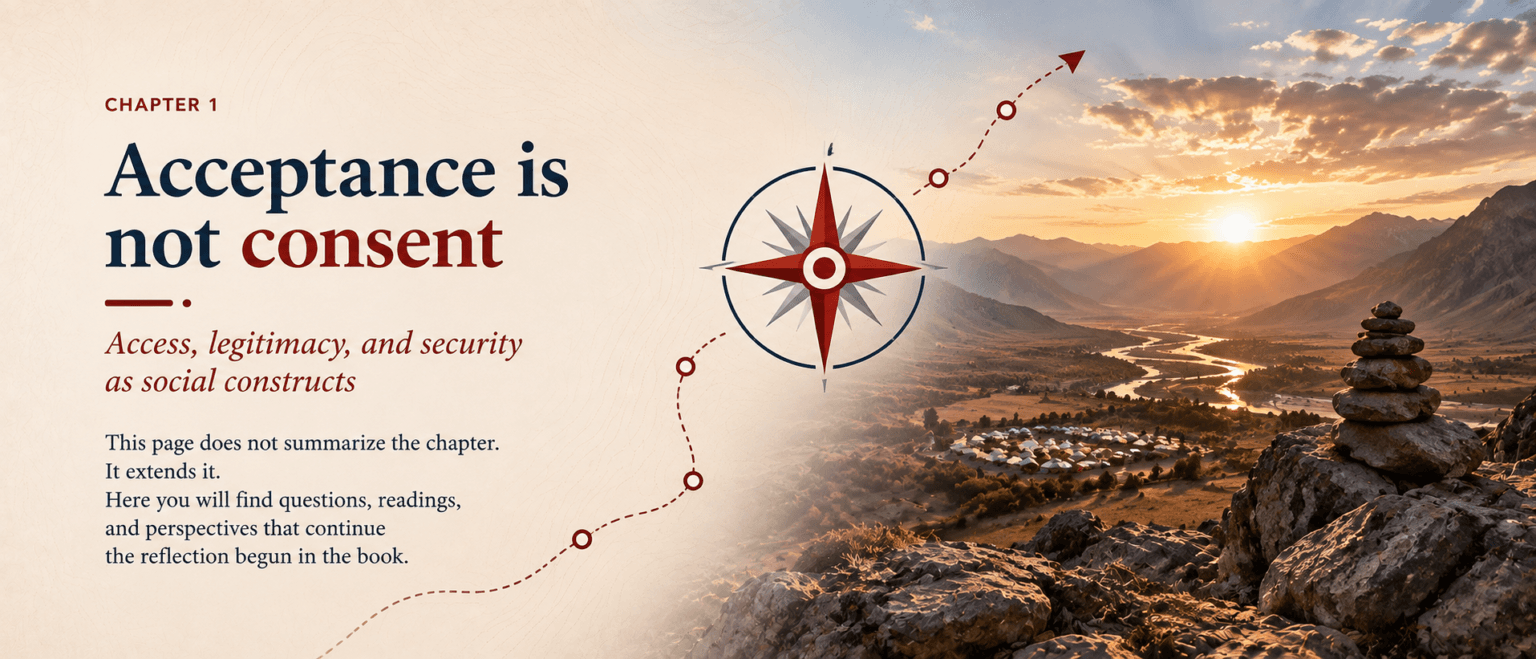
Acceptance is not a state, but a relationship that is continuously renegotiated.
It is rarely withdrawn through an explicit announcement.
More often, it deteriorates slowly, through small changes that, taken individually, may seem insignificant: a meeting postponed, a visit that feels less spontaneous, a question left unanswered, a silence that was not there before.
The challenge is not recognising the moment of rupture, but noticing the process that precedes it.
For this reason, acceptance is not only a matter of humanitarian principles.
Above all, it is the ability to read the context.
Questions That Remain Open
When does acceptance stop being a relationship and become an organisational illusion?
Which signals do we tend to ignore because they do not fit into our monitoring systems?
In what situations does security depend more on the quality of relationships than on the quality of procedures?

To Continue the Journey
The Far Side : The Meta Functions of Humanitarianism in a Globalised World - Antonio Donini
A fundamental analysis of the political and relational dimensions of humanitarian action, showing how humanitarian action is not only a response to needs, but also a system of relationships, power and legitimacy. Acceptance emerges as a social construct rather than simply an operational strategy.
Read More →
What It Takes: Principled Pragmatism to Enable Access and Quality Humanitarian Aid in Insecure Environments -
SAVE Program
One of the strongest recent studies on the relationship between access, trust, operational independence and the quality of assistance. It shows that access does not depend on a single strategy, but on a continuous balance between relationships, context and legitimacy.
Explore Further →
Humanitarian access: What the Law Says -
ICRC
An authoritative overview of the international legal framework governing humanitarian access. It helps distinguish between what is protected by law and what, in practice, continues to depend on relationships built in the field.
View →
What It Takes: Principled Pragmatism to Enable Access and Quality Humanitarian Aid in Insecure Environments - Humanitarian Outcomes Podcast
A conversation with researchers and practitioners on the meaning of humanitarian access, presence in the field and relationships with communities. It reflects on how trust is built and on the capacity to remain accepted over time.
Listen →
Humanitarian Access Playbook -
Mercy Corps
A collection of cases, tools and experiences showing how an organisation seeks to translate the concept of access into everyday practice. Not as a model to replicate, but as an opportunity to compare different approaches.
Explore →