Chapter Reading Time
22 minutes
Key Concepts
Ethics of Decision-Making – Personal Responsibility – Difficult Choices – Consequences – Judgement
Guiding Questions
At what point do we continue to defend a decision simply because it has already been made?
Explore Further
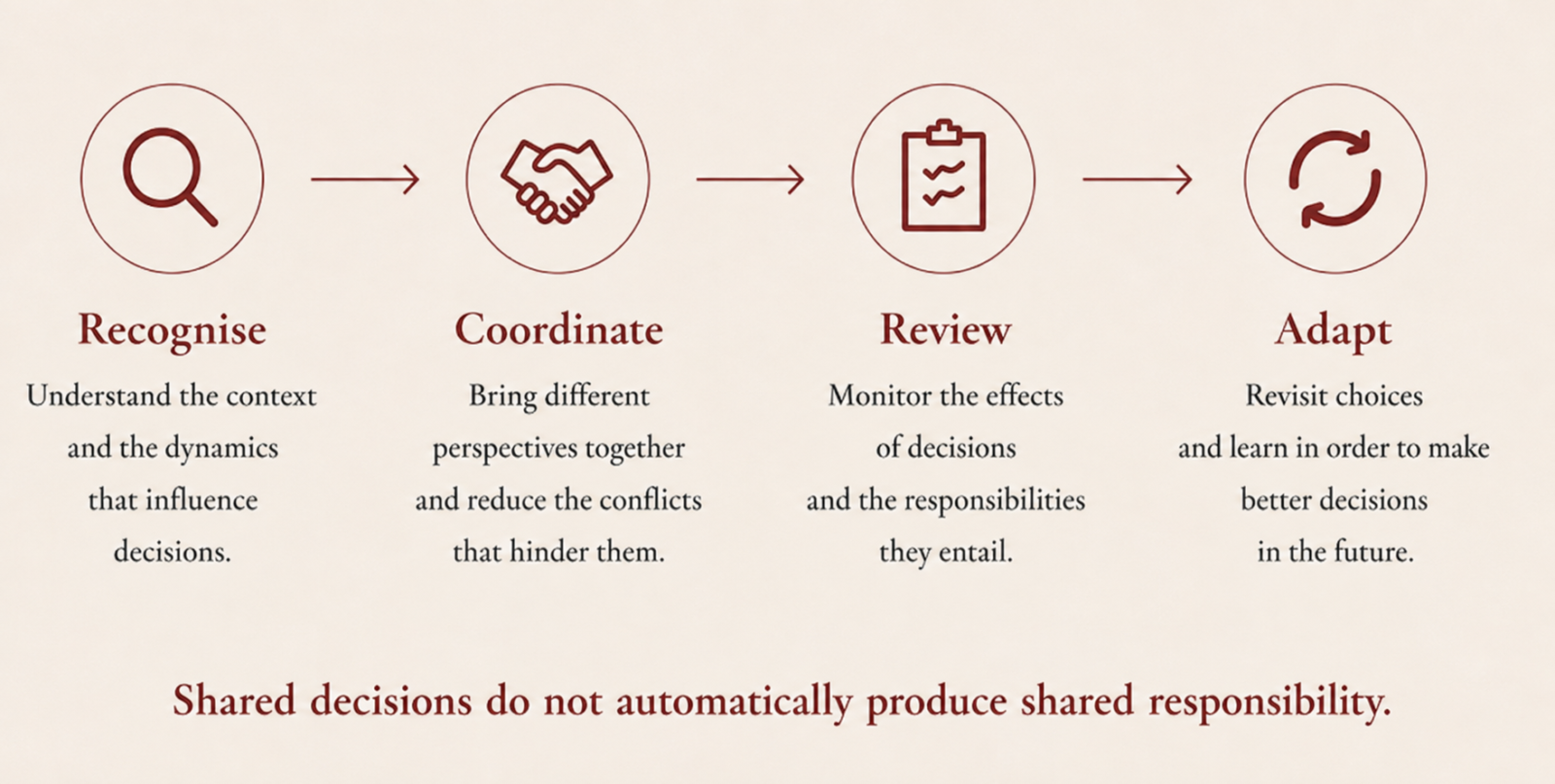
Every decision continues through its consequences.
What follows — the consequences, the reactions, the doubts, what we discover afterwards — remains part of the decision.
The most difficult choices are not defined by being perfect, but by the fact that someone continues to live with them even when they become uncomfortable.
The ethics of decision-making does not consist in finding an unassailable answer.
It consists in not abandoning responsibility when the context changes, when new information emerges, or when the choice proves less straightforward than it first appeared.
The quality of a decision does not depend only on what we knew at the moment we made it.
It also depends on how willing we remain to revisit it.
Deciding without shelter does not mean deciding without direction, but accepting that some responsibilities cannot be fully transferred to processes or to time.
Questions That Remain Open
When does changing our mind become an act of responsibility rather than a sign of weakness?
Which consequences are we willing to take personal responsibility for, and which do we tend to transfer to the system?
When does the desire to avoid making a mistake become a way of avoiding responsibility?

Room for Manoeuvre
Responsibility continues after the choice.
Deciding does not simply mean making a choice.
It means taking responsibility for what follows.
The room for manoeuvre does not end with the decision.
It continues in our ability to remain responsible when the context changes and the consequences become part of the choice.
It is not about always being right, but about not disappearing
once the decision has been made.
To Continue the Journey
Ethics in Humanitarian Action -
ICRC
A collection of ICRC reflections on some of the central ethical dilemmas of humanitarian action: neutrality, impartiality, risk, responsibility and decision-making in situations of conflict and crisis.
Read More →
Humanitarian Ethics: A Guide to the Morality of Aid in War and Disaster - Hugo Slim
A key work on the ethics of contemporary humanitarian action. Slim examines the moral dilemmas that arise when every decision carries consequences that are difficult to avoid, showing that ethical responsibility does not lie in the mechanical application of principles, but in how we confront the consequences of our choices.
Explore Further →
Humanitarian Charter -
Sphere
The Humanitarian Charter provides the ethical foundation of the Sphere Handbook. It reaffirms the right of people affected by crises to receive assistance and protection, and offers a framework for guiding professional judgement in the most difficult decisions.
View →
Fresh Humanitarian Perspectives Podcast - Humanitarian Leadership Academy
Conversations with humanitarian practitioners, leaders and researchers on the challenges of leadership, personal responsibility and decision-making under conditions of profound uncertainty.
Listen →
Learning Resources & Webinars - CCHN
Videos, webinars and practical case studies showing how many humanitarian decisions take shape through negotiation, uncertainty, compromise and shared responsibility.
Explore →