Chapter Reading Time
24 minutes
Key Concepts
Safeguarding – Accountability – Quality Standards – Continuous Improvement
Guiding Questions
When does a procedure genuinely protect us? How can we tell whether “doing things well” is enough?
Explore Further
When “right” is still not enough
Humanitarian organisations need procedures, standards, audits and accountability systems.
Without these tools, many people would remain without protection. But the risk begins when we start to confuse compliance with responsibility.
A procedure may be followed.
A standard may be met.
An audit may be passed.
And yet someone may still remain invisible. The question, then, is not whether we did everything correctly.
It is whether what we did was truly enough to protect. Quality does not arise from the absence of errors.
It arises from the willingness to keep questioning what we consider sufficient.
Questions That Remain Open
When does a procedure protect us, and when does it primarily protect the organisation?
Which people still remain invisible in our quality indicators?
At what point does “doing things well” stop being the same as “doing enough”?
Room for Manoeuvre
WHEN “ENOUGH” IS NOT ENOUGH?
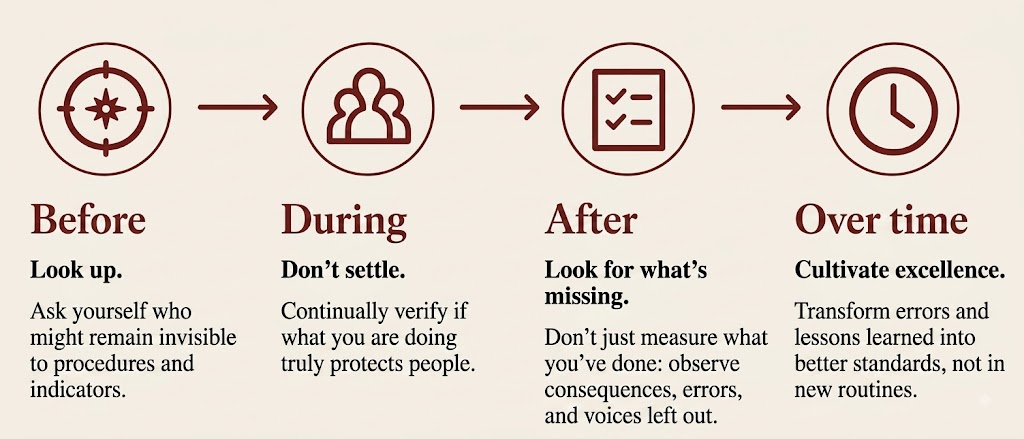
Before considering a task complete, ask yourself whether you have done what was required, or what was truly necessary.
Procedures, standards and indicators are tools, not the final destination.
Look for what does not appear in reports, listen to those who remain at the margins,
and question what works only on paper.
Quality begins when we stop confusing compliance with responsibility.
To Continue the Journey
Core Humanitarian Standard on Quality and Accountability - CHS Alliance
The international standard that defines what it means to provide quality, accountable and people-centred humanitarian assistance. More than a set of technical requirements, the CHS promotes a culture of responsibility, dignity and continuous improvement.
Read More →
Transforming Change -
Paul Knox Clarke - ALNAP
A reflection on how humanitarian organisations genuinely change. The paper shows why procedures, standards and policies alone are not enough to transform organisational culture, and why meaningful change requires leadership, learning and shared responsibility.
Explore Further →
Minimum Operating Standards for Protection from Sexual Exploitation and Abuse (PSEA) - IASC
The international reference for the prevention of sexual exploitation and abuse in the humanitarian system. It sets out the minimum requirements that every organisation should have in place to protect people from abusive behaviour.
View →
Podcast on Humanitarian Standards –
HQAI
A conversation on humanitarian standards, power dynamics, the Core Humanitarian Standard, and the gap between formal commitments and operational practice.
Listen →
Independent Verification of Humanitarian Quality - Humanitarian Quality Assurance Initiative (HQAI)
Videos, webinars and practical case studies showing how humanitarian standards can be assessed, applied and improved through independent audits, organisational learning and quality processes.
Explore →